We keep getting back on the bus — Part 2

Art where you wouldn’t expect to find it.

Let’s begin this episode (Part 2 of ‘We keep getting back on the bus’) with a quiz – ‘cuz why not? Here’s the question: In which of the following places here in The Land would one be likely to find an art museum?

  1. Atop Har Halutz (where The Levines live)
  2. At the northbound rest stop on route 6 (next to the Chabad trailer)
  3. On the grounds of the historic Kibbutz Ein Harod
  4. In the alleyway outside Power Coffeeworks on Agrippas St. in Jerusalem          

Are you surprised that the correct answer is #3? Would you be more surprised that the Mishkan Museum of Art is the oldest art museum in Israel?  Would you be even more surprised that the museum is a National Heritage Site and is considered one of the three top art museums in the country? OK then, how is it that I never heard of it before? That’s my question. For that one, I have no answer, but there you have it.  That’s the reason for these Study Trips, so you might learn something amazing to share with invited guests around a Shabbat table.

There we were, being ushered into the museum, where we would be guided by Deborah Liss, the curator of their Judaica collection. She had arrived in Israel as a starry-eyed young person with a background in Art History and began working at the museum thirty years ago. (Thirty years ago? Did you study Art History in kindergarten?, I asked her. But then, at my advanced age, almost anyone under fifty looks like a recent high school graduate.)

No matter, there was work to be done. Standing in the main gallery, she first gave us a general introduction to the museum and its collection. (‘Standing’ doesn’t do her justice; perhaps ‘gliding,’ dancing,’ ‘moving to the rhythm of her speech’ would be more to the point.) The main exhibit on display when we were there (they do change their exhibits from time to time, plus they were in the process of reimagining, reconceptualizing how to use their space) was a potpourri of work by, shall we say, mostly not-as-well-known Israeli artists who are deserving of quality wall space to show their stuff.
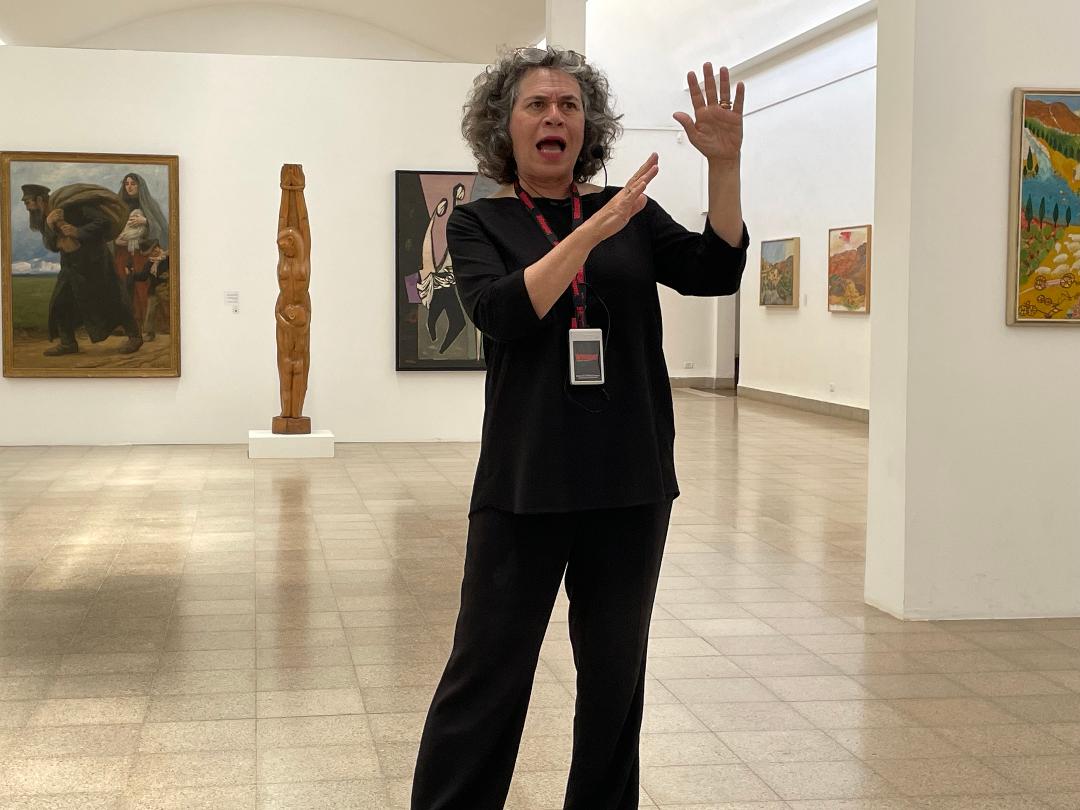
Then we headed to the curator’s pride and joy, the Judaica gallery. The museum administration had noted, over the years, a general lack of interest in their collection of Torah covers, parochets (the curtains that are hung in front of the arks where the scrolls are kept), and the other paraphernalia found in your standard shul. Of course, if you can see similar items on display in your standard shul…? (I’ll be waiting in the bookstore, Martha.)

Why not mix it up a bit; do a little compare-and-contrast; intersperse the tried and true with some more contemporary items in serious need of display time?  Here’s a fellow who took some of his late father’s effects (shirt collars, ties) and made them into Torah covers. That’s different; I like it.

But what Ms. Liss wanted most to talk about was an old parochet that, if I were just walking by, I wouldn’t have given a second glance. It’s quite large – meaning it was made for a large aron kodesh in an impressive synagogue. But look what it says about itself. I was donated to the xxx synagogue in Wurtzberg, Germany in 18xx by so-and-so, the son of what’s-his-name and his wife, what’s-her-name. This large piece of red cloth was among the kazillion items stolen by the Nazis, some destroyed, some kept as a reminder of the chutzpah of the Master Race. Many of these ‘souvenirs’ were repatriated by the Allies in 1945 and distributed among Jewish organizations in Israel and the Exile, which is how this parochet came to Ein Harod.

I imagine that every art curator worthy of his/her name is also a detective of sorts. Given the information carefully provided in Hebrew letters, what more can we find out about the provenance of this parochet? It’s from Wurtzberg; if nothing else, they keep good records in that part of the world. Our fearless curator contacted a German source. You’re reading it wrong. It’s not so-and-so, the son of what’s-his-name and his wife, what’s-her-name. It’s so-and-so (the son of what’s-his-name) and so-and-so’s wife, Mrs.-so-and-so. That’s different! With that emendation, the Gentile lady in Germany was able to figure out who was the generous donor. Most likely, the donation was made in honor of the birth of a daughter, the so-and-so’s tenth child. As a bonus, the source was able to do a little genealogical research. There may be a very distant relative alive in Israel today. That’s quite a story, one I would not have heard if I were on my own, wandering on an afternoon through the museum. As I’ve said before, that’s the value of these trips.

We meet more women named Deborah along the way

When we walked into the Emunah Children’s Home in Afula, we were met by a Deborah and a Debbie, both officials of the organization, who welcomed us effusively. We were one of the first post-COVID groups to visit the facility. (I see they have set out a little spread for us, but didn’t we just have lunch?) However, it was Shlomie, the person in charge of the facility, who gave the main presentation. Whether or not he had planned to talk about the specific situation, it was definitely on his mind. Years before, a man had killed his wife, the mother of his eight children, all of whom were placed in various foster facilities, which is how the boy in question arrived at the Children’s Home. He stayed there for a number of years and was adjusting well; he had been selected for a pre-army program that would assure him a spot in a prestigious IDF unit. Then, just before graduation, he fell apart – who knows why – and started to act out big time. He had to leave the Home and go elsewhere. Everything was going wrong for him. Ten minutes before our group arrived, however, he showed up at Shlomie’s office. At least for the moment, the young man was back on track. Let’s hope.

What Shlomie emphasized – although he didn’t have too (at least for me, who spent twenty years working in Child Welfare in NYC) – was that the boys and girls who reside at this facility or are in their after-school programs are not just random kids off the streets. Every one of them has had something terrible, something tragic, something abusive, happen to them in their young lives and would need a lot of support and intervention to overcome their childhood disasters.

We would get to meet some of these young people. There would be both a baking and a woodworking workshop, and we could participate in either one. For most of the couples in our group, the guy left to go elsewhere for the woodworking session and the wife stayed where we were for the baking. But you know we’re not normal. I flunked woodworking in J.H.S., and it’s been all downhill ever since. I stayed put, hoping to get some photographs to share.

About a dozen girls, ranging in age from –I’m guessing – eight to fourteen came in and sat down on one side of a long table, with our women, all of whom are mothers and grandmothers, sitting facing them. Both sides pitched in and rolled the prepared dough into cookie-sized pieces, which were taken into the kitchen and baked. (Yum!) I have a few excellent shots that I’d love to share of the interaction between these young ladies and our somewhat older ones, but we were admonished: NO SOCIAL MEDIA, so I can’t. One thing you would notice right off the bat is that these girls – and the other boys and girls we encountered playing ball outside – don’t look like the victims they in a sense are, which I guess is the point of the program. Those of us who had gone out to watch the woodworking came back with souvenirs: little wooden boxes. That’s OK; we got cookies. I couldn’t help but remember my failed attempts in Mr. Dicristofaro’s shop class back at J.H.S. 80. That was almost seventy years go – but who’s counting.

Sami Sanchet, front and center

A few Study Trips ago, Sami Sanchet got the assignment to ferry our group around. Our travelers were so impressed with his driving and his helpfulness that they asked, insisted, demanded, that he be the regular driver on all future trips, which is what has happened. When he’s driving our group, he leaves his home in Kafr Manda, an Arab village in the Galil, at some insane hour in the morning, drives down to Jerusalem so we can board the bus and be on our way by 8 AM. He’s with us the entire time. When our four day excursion is over, he drives our group down to Jerusalem and then drives back to his home up north. That’s a lot of driving, but, as he told us, for him it’s easy.

Make of it what you will, but usually at breakfast and dinner at whatever hotel we’re staying at, the bus driver – whoever he might be – usually sits by himself, maybe with another driver, once in a while with the tour guide. This trip, Barbara, being the special person she is, invited him to join us for some of the meals. So we got to learn a little about his life.

For many years, he made a good living printing patterns onto fabrics. And then….. Remember my reference in Part 1 to the large we’ll-steal-whatever-you-come-up-with nation in the far-east. You guessed it; all the work in this industry headed their way, and Sami was out of a job. For most of us, driving a bus is not anything we would choose to do – especially driving the length and breadth of The Land for days on end. (For one thing, you’d need a better bladder than I have.) But, as Sami said, for him it’s easy.

On the last trip (#182), Sami suggested to the powers-that-be (a/k/a Jeff Rothenberg) that on the next visit to the Galil we visit his village. Now that’s different. Just about everywhere we go on these trips, there will be other busloads of people seeing the same thing – if not exactly when we’re there, then sooner or later. But who gets a guided tour of Kafr Manda? The offer was duly accepted, and off we went.

Kafr Manda, for those who are interested, has been part of Israel since the very beginning (think 1948), and its residents, from what I’m told, are reasonably satisfied with that arrangement. The person doing the telling was Mahmoud, a brother of our driver, and the principal of one of the middle schools in the village. Sami, after giving us a short ride around the town, pulled up his bus in front of the school. From my seat, I could see the Israeli flag fluttering on a pole atop the building. We were met by a few of the teachers, including the English teacher, a conservatively dressed Arab woman, who actually spoke decent English. (Unlike the Russian woman who taught The Levine’s son Ari in years gone by, whose English was as good as my Hebrew.) We were ushered inside into Mahmoud’s office and from there upstairs to a classroom – unfortunately empty. (We were supposed to meet some of the students, but there just wasn’t time for that.)

Mahmoud, who doesn’t have a background in education, was brought in several years ago to straighten out the school, and he evidently has done that. Eighty percent of the kids in his school pass their ‘Bagruts.’ The building looks in a lot better condition than the schools we go to in Ma’ale Adumim to vote. (Sadly, I can see another such visit coming shortly.) The principal told us that if there is something he needs from the Ministry of Education, he can pretty much get it. The funding arrangement has been changed; all the money for the school comes directly to him instead of to the village administration – so no sticky fingers get in the way.

When Mahmoud was done, it was time for questions. Actually, one of the questions came from the English teacher. Why did you come here? Well, Sami invited us and drove us to your doorstep, that’s why. But could we give a better answer than that? My wife accepted the challenge. She pointed out that we are surrounded by Arab villages, but we never get to go to any of them. (What she didn’t say was that there are big red signs with white letters telling one and all that it would be dangerous for Israeli citizens to set foot within.) Here was our opportunity to see how our neighbors live. Point well taken.

I had hoped to ask a question, but, again, there just wasn’t time. One woman we know teaches in a school in Ma’ale Adumim. She is constantly frustrated by the lack of discipline in her school. Every parent here ‘knows the mayor,’ and if there’s a problem with her little darling, the parent will threaten you. (There are often attempts to solicit people like moi, who are qualified to tutor English in local schools. Are you nuts???!!!! You couldn’t pay me enough to deal with Israeli teenagers. The best performing school in Israel year after year is in a Druze village somewhere up north. What’s their secret? They don’t take any b.s.; not from the students, not from the parents, so the kids learn. Simple.)

I was wondering how they deal with discipline in Mahmoud’s school and what kind of problems they face, but, again, there just wasn’t time to find out. Sami’s family was preparing a modest spread for us, which turned out to be enough for lunch. He had worked with Aliza to make certain that we could eat everything –no glitches, no embarrassment. We sat in the yard next to Sami’s house. (In typical Arab fashion, he and his wife occupy the first floor, with the second floor reserved for a son when he comes of age.) Were we in an Island of Sanity in a troubled world? Perhaps. If only good will were as contagious as stupidity; we’d all be better off.

Just as every other Study Trip we’ve been on, this one was coming to a close. We first bid farewell to Aliza, our tour guide. Her husband was meeting her along the way, and the two of them were heading down to The Gush for a wedding. As I mentioned, Sami would drop the group off in Jerusalem and head back up north to Kafr Manda. He thanked the group for coming to his village and for inviting him to join us in the dining room. I began to realize how much these gestures meant to him. He wasn’t just somebody driving a bus; he belonged. Isn’t that how all of us want to feel – that we’re not some random stranger, there to do a job and then goodbye? That we belong? That we’re Somebody? Food for thought.

We Keep Getting Back on the Bus — Part 1

Two tried and true truisms

There’s this old truism, what goes up must go down. You’ve heard it once or twice in your lifetime. As it applies to yours truly and the social director, having been on a tiyul to the Upper Galil, inevitably we would wind up getting back on the bus headed to the Lower Galil. And that’s what happened. We came back last week from another AACI study trip (#183, if you’re counting), similar in concept to the ones we’ve been on before, getting to places and meeting with people we would never be able to on our own. Led by our wonderful tour guide, Aliza Avshalom, we began our exploration of the region at kibbutz Magal, home of the Netafim drip irrigation systems.

Continue reading

It Happened Last Week

Only the Last One

Almost always, Nachum’s shiur (between mincha and maariv on Shabbat afternoon) is just that, an opportunity for him to present the material he has prepared, with only an occasional question or comment from the Peanut Gallery. The previous Shabbat – when the Torah portion read in The Land was Kedoshim – was different. It was the first Shabbat when we weren’t required to wear masks in shul, and the somewhat larger group in attendance was feeling somewhat frisky, perhaps thanks to our newfound ability to breathe. Plus, Nachum began his talk with a question, inviting us to put in our own two cents (although there’s no coin of the realm that small in Israel).

Continue reading

Party, Party!

They’re having the party at Beit Boyer, which is on Efrata in Jerusalem. Do you happen to know where that is?

I replied, I know exactly where that is. We (Encore!) rehearsed there for the longest time until – I guess – they got tired of us using their space. I could find Beit Boyer in my sleep.

It does help, if you’re invited to something, to know where you’re going. And we were heading to a belated celebration of Batya’s getting married – well worth a trip out to the far reaches of Jerusalem.

Continue reading

Back on the Bus Again — Part Two

The cranes are flying (not)

I still have fond memories of the time, ages ago, when we visited the nature reserve at Hula Valley with June and Jeff. It was then peak season – at least for the cranes. There were thousands of the birds hanging around with a collective knowledge that a strange beast would show up out of nowhere and scatter food for them all around. We were there in the late afternoon, and when dusk came, one part of the flock would ascend in unison, flying to where they would spend the night. When one group was finished, then and only then would another group take off, until every single crane was snug and comfy for the evening – all without an F.A.A.-approved tracking system. Makes you wonder.

This was another place that would fit into the Yeah, we’ve been here before, but it’s worth another visit category. But now, when our bus pulled up to the entrance to the nature reserve, it was well past peak season. Most of the migratory birds were already on their way to their summer quarters in Eastern Europe, meaning they would be flying through the Ukraine – not the safest place to be these days, but old habits die hard.

Therefore, our experience was not the same. We had the blind (a moving set of bleachers that would take us through part of the preserve) all to ourselves, with an English-speaking guide to provide commentary. There was little to break the silence around us, so any sound or avian movement was magnified in importance. It was the undisturbed, everyday quiet of the evening, at least as profound in its way as the touristy Hula Valley we had experienced before.

Priorities

We did have one additional stop that day, and, to my mind, it was more about priorities than anything else. (Visit the Neot Art Studio & Gallery and Teva Naot factory store at Kibbutz Neot Mordechai.) We had about an hour to spend at the kibbutz, and we were each given a choice: either spend the entire time at the shoe store or half the time at the ‘art gallery’ and the rest at the store. For Barbara and me, option #2 was a no-brainer. I had purchased a new pair of sneakers months ago, so I was good-to-go as far as my feet were concerned. Barbara? Let’s just describe her as tabernaphobic, a fancy term I just made up, which means someone who hates shopping. (If it’s OK with you, we’ll just watch the shuffleboard tournament instead.) Let’s first check out the other place. Of course, it wasn’t an art gallery as is commonly understood. It was instead your typical crafts shop, full of hand-made items to use around the house, framed pictures, ‘antique’ clothing, and the like. I wound up buying two bars of soap at 24NIS apiece. (Gotta buy something…)

But we listened to the two women who ran the place describe their efforts to provide a venue for local artisans to display and sell their wares. Fair enough, and bully for them. The world can always use a few more tchakeles.

We had previously visited another Teva Naot outlet down in the Gush, so we knew what to expect: a store that combined full retail prices with a wholesale shopping experience: hundreds of shoes spread out on tables and racks for the avid shopper to search through, maybe finding something suitable, possibly in the right size. Many of our party chose to ogle the monochromatic display of footwear for the whole hour, but they were given a choice, and they chose. As I said, priorities.

Life on the border

And then there was the category, I have no idea what this one is about, but it might be interesting. The next morning, we were scheduled to ‘Hear about life in the shadow of Hezbollah from local resident, Eitan Oren, at Kibbutz Malkiya on the border with Lebanon.’ They weren’t just talking through their hat; the kibbutz is as close to the border as you’d ever want to be. And Eitan Oren definitely fits into the category of special people we would otherwise never get to meet. Here’s a guy who’s been around the kibbutz a few times, spending a lot of it with his eye focused on a mountain across the border where trouble, and nothing but trouble, (spelled H-E-Z-B-O-L-L-A-H) is afoot. For a long time, he was the head of the civilian patrol that works closely with the IDF, although these days he lets some of the younger guys with a little more speed and stamina take the lead. However, for P.R. and taking folks around, he’s the guy.

Like the communities near Gaza, the kibbutz is dotted with shelters. The whole bunch of us went down the stairs and huddled together in the underground shelter set aside for children right next to their school. The kibbutzniks have made a reasonable effort to fill the place with games and toys, but there’s only so much you can do to make an underground bunker seem cheerful.

In the short time before Eitan showed up to take our group around, most of us had drifted into the community store. Remember, it was right before Purim, and we were told that we would be meeting some soldiers, and maybe they would like some Purim nosh(?). That’s all the hint the group –most of whom were bubbies and zadies – needed. Like locusts – or maybe cranes – cleaning out the crops from a field, these super-Zionistic elders bought out every sugar-filled and salt-covered snack in the place, just in case the soldiers wouldn’t have enough to eat without our junk food. (I purchased a box of hamentaschen to add to the pile.)

If we were going to meet soldiers, it wouldn’t be in downtown Malkiya. We would have to go out to the nearby fields. One of the interesting factoids we learned on the trip was that a hefty percentage of the kiwis grown in The Land come from this kibbutz. That’s where we were headed next. Most of the fruit had been picked, but there was enough prudently left on the vines from pre-shmittah to hand out samples to visitors. Eitan reminded us several times to stick together as a group. This area is closely watched, not only by Hezbollah, but by our own troops – actually, a passel of young women staring at monitors around the clock, watching for any suspicious activity. Any one of us wandering off might produce a jeep or two full of soldiers coming to investigate.

A little too close to the border for comfort

A jeep did show up as we were standing with Eitan amidst the kiwi vines. The man who got out – past middle aged – was not a soldier, although he had been once, part of the South Lebanese Army that had fought alongside of the IDF in that bygone campaign. He is now living and working on our side of the border. Part of his family is here; one son is in The States, and it is only through that son that our man is able to communicate with daughters still in Lebanon. I have a fine photograph of him and Eitan, which I was going to include. Then I thought, is that a good idea, to show his face? To be on the safe side, I’ll show you one of Eitan peeling his kiwis.

Eitan peeling a kiwi

Awhile later, an IDF jeep showed up. Maybe they had sniffed out the goodies awaiting them, or maybe it was a routine patrol. We loaded enough junk food in the back of the jeep to keep them snacking for a long time. Eitan prudently withheld a small selection of treats just in case. We were supposed to meet with more IDF-ers, but it turned out they were on maneuvers or some such at the time. We left our remaining goodies with another jeep that passed by. I guess that’s part of their training: sniffing out parcels of food from well-meaning visitors. The food on the base isn’t always the best, or so I hear.

Now that we had come across a real live member of the South Lebanese Army, it was only fit and proper to head up to Metula and visit the Good Fence, and the new memorial – long overdue – to the Lebanese soldiers who were not as fortunate as the fellow we just met. While most of our group wandered around the memorial, a few of us more adventurous guys with actual cameras, began exploring the ghost city, the forlorn remains of what had once been the border compound. So much real-life drama had occurred here not that long ago, and now…. Well, see for yourself.

What is left of the border crossing

The Overlooked Slab

The final day of our tiyul took us back to Rosh Pina and the cobblestone streets of the artists colony. We were welcomed into the old synagogue, built by the Rothschilds – we’re talking about 140 years ago – that, in a way, typifies the community. When the original Zionist pioneers came to the area, it was winter, meaning rainy season. When they came back in the summer, bringing with them boats to traverse the lakes they assumed would be there, they realized their folly. They dismantled the boats and used the timber for the roof of the synagogue, painting clouds all over it. Like the rosh pinah of the psalms (the overlooked slab that became the cornerstone – I’m not sure of what), the synagogue suffered from its own neglect, as in no daveners, no minyans. Now there is a rabbi, the kind that makes you feel you belong there, which is not every guy with smichah. There is renovation and restoration throughout the building, and, most important, there are now regular minyans, which is only fit and proper for one of the original Zionist settlements in The Land.

Jacky Sivak and the rabbi

If you’ve ever walked on cobblestone pavement, you know that they are picturesque but hard to deal with when they’re wet.  It had rained on and off that morning, so we carefully and gingerly walked up the hill to Nimrod Observation Point. We were supposed to meet with the builder of the site, Hezi Segav, the father of Nimrod, who, along with several young men under his command, was killed in battle during the Second Lebanon War. The senior Segev, however, was elsewhere, so we missed his talk. We walked around and looked at the signs, but it wasn’t the same without the explanation. (Which is exactly my point!) However, the view from the top looking down at the valley was quite impressive.

I didn’t even notice the wind chimes that graced the observation point. The only reason I finally realized they were there was because we spent part of the afternoon with Ofer, in whose studio, Pa’amonei Yerushalayim, (he started out in Jerusalem) these chimes were made. Wind chimes are not a big feature in the Casden household, Barbara taking after her mother, who once disabled the clatter from the offending device in a neighbor’s yard. Still, his explanation about the science of making a set of properly tuned chimes was fascinating. He claims that there is a meditative quality to the chimes, but the jury is still out on that one.

Nestled behind a gas station was the Woodsong Studio of Peter Isacowitz, who makes an assortment of musical instruments: harps, xylophones, and weird contraptions that must have names, but I don’t know what they are. Barbara had an idea, actually a good idea. We needed to get a gift for Liel, our step-grand-daughter. We were considering the usual: a book, a puzzle, or some such. How about a kalimba instead? I figured that she and her parents would either love it or hate it, but it’s worth a try. It is different, after all. She apparently did appreciate it. I hope they’re not just being polite.

Peter Isacowitz

From there, our bus headed south and east, making the same stops and winding up back in Jerusalem. And that was our trip. (Needless to say, our purchases from the Adir winery were properly stored in our luggage and made it home safely.) There’s another one scheduled in May, and we’re going –whether I like it or not. Of course, I will like it; I have strict instructions to that effect. (Remember: always listen to your wife!)

Back on the Bus Again — Part One

Never let the cole slaw get you down

Oh no. Not again! If I have to cancel this trip after having been COVID-ed from the excursion to Egypt last month, I don’t know what I’ll do. Maybe never sign up for any such jaunts in the future because it’s not worth it. The AACI study trip #181 – Upper Galilee (bus 2) was scheduled to depart bright and early on Sun. March 6, and here it was the day before – Shabbat – and my insides were in rebellion. Not a good sign, not at all. It turned out in the end to be a simple matter – as in the coleslaw I had nibbled at Fri. night, which had been sitting in the fridge a little too long. By the time Shabbat was over, I was pretty much fit as a fiddle, a much happier camper, ready to finish packing and head out crack of dawn the next day.

To tell the truth, I hadn’t been that eager to go on this excursion. We’ve been here; we’ve been there before. A lot of the other places don’t seem that interesting. So I’m not that excited. But Barbara really wanted to go. She needed to go somewhere, just to get away after the Egypt debacle. (Note to self: always listen to your wife. Life is better that way.) And I had to admit, even the AACI study trips I had been on just to please my life-mate had turned out to be winners. Plus, it had been two years since our safari to Tanzania, the last time I had an opportunity to do any extended photography. So why not just go, enjoy myself, and, on a good day, get some photographs worth sharing?

Continue reading

Conversations

I’m going to go way out on a limb and make the following claim with a feeling of absolute certainty. Not a single person reading this post has had a conversation in the last six months in which the affairs of Tzarina Yekatarina (a/k/a Catherine the Great) was a topic to be discussed. Am I right? However……. A few weeks ago, a fellow whose company I much enjoy was sitting in my living room, and, sure enough, he started talking about the tzarina – as in her ability as absolute ruler over all of Russia to select and purchase whatever works of art she wanted with an unlimited budget and no one to say ‘no’ to anything she chose. I won’t go into his train of thought, but it led him from her autocratic rule to the role of today’s ‘self-selected’ art critics and curators, who decide on their own what works will be shown in publicly funded museums. My friend’s point was that decisions on these matters should be made wholly or at least in part by ‘elected officials.’

Continue reading

Simpler Is Better

The Case of the Clam-Shell Phone

Many of my conversations of cosmic importance take place when we and The Levines are sitting around a table, and quite often one of the main topics to be discussed is Barbara Levine’s vintage cell phone and its presumed limitations. Richard can be accurately described as a gear guy and, more precisely, as an i-Gear guy. Yes, he has a Windows machine at home, but when he comes our way, he travels with a Macbook, an iPad, and an iPhone. Let us not forget the iWatch on his wrist, a farewell present when he retired a few years ago.

Barbara Levine does bring a small iPad with her, with which she follows all the feeds and posts of interest to her. But there by her side, for as long as we’ve known her, is a little clam-shell phone, vintage 1874. There are lots of things one can’t do with this device, but one can make and receive phone calls as proficiently as with a more feature-laden phone, and with a little effort, one can even do text messages, which is all she needs or wants from a phone. Plus, anyone can make necessary repairs to it with little or no training. All that needs to be done is use a fresh batch of ‘Scotch tape’ to make sure the case doesn’t fall apart.

Barbara, being the engineer that she is, will explain that the more features, the more functions, the more parts, a device has, the more likely it will prematurely shuffle off this mortal coil. If you don’t believe it, just wander over to your local landfill, a cemetery for shiny toys that have met an early demise. The point being that simpler is better, which is the topic of this article, for you to enjoy and me to vent my frustrations. So here goes.

Sometimes, we are urged, pressured even, to join the party and upgrade to a newer contraption. When Richard purchased his new iPhone recently, he bequeathed his older model to Barbara, which she accepted grudgingly, muttering under her breath all the while. She may be using it, but she still carries her clam shell with the tape around it. Even I felt the urge to do an upgrade. My iPhone 6, which I purchased six and a half years ago, worked just fine, but it was becoming less and less compatible with a newer generation of apps and the annual upgrade of IOS. As friend Ezra was heading down to Eilat – where they don’t charge the 17% VAT – I figured it would be a good time to move on to a more current iteration.  He came back with an iPhone 12 for me, and we spent a few hours moving over the data and setting up the phone to do all the newer and better things I couldn’t do before, one of which was being able to load my rav kav from the comfort of our home.

We’ve come a long way from how you paid for your bus ride back in 2007 when we were newbies here in The Land. The driver no longer has to make change while he’s driving – not the safest way to conduct business – nor would we have to go all the way to the Central Bus Station in Jerusalem to renew our monthly pass. Just use the app on your phone.

Simple? Not so simple. Downloading the app is not the problem; using it is. You have to hold your rav kav next to the phone in a certain way so the app and the card are talking to each other. But the real difficulty has to do with attaching your credit cards. Using the method we started with, we started adding them to Apple Pay. Easy enough, except that you need to receive and enter an access code to validate the transaction. Let’s try our Capital One Card. OK, it’s sending the code to….. an American land line. (As we all know, land lines are not the preferred way to handle text messages.) I’ll have to call the phone number on the card to straighten out the problem. I’ll do it tomorrow; except that ‘tomorrow’ is always tomorrow – if you get my drift. With a phone call or two and a little effort, we were, however, able to validate my two Israeli cards. I should have been good to go; wrong!

Somewhere in the ether, in that part of virtual reality that deals with petty cash, are floating several hundred shekels of mine, meant to pay for my transportation throughout The Land, but never accomplishing that task. In simple English, I wound up taking money out of my Bank Leumi account but never transferring the shekels onto my rav kav, which is why I wound up stranded in Jerusalem, unable to pay my way back home. You can see why I’m a bit leery of this pay-your-way-by phone business. Ezra was explaining to me how he’s started to do just that, flashing his phone to buy things. I had to ask him, OK, you’re a gear guy, and I understand the temptation to strut your stuff, but you’re taking the credit card you already have, adding it to your phone, and using that instead of the card. That’s simply an additional step. How does that make life any better, any easier? Understand, that was a rhetorical question; I didn’t expect an answer, and I didn’t get one.

Male Chauvinist Alert

It’s not easy to attribute motives to mechanical devices, and I know I’m on thin ice here, but I have to believe our new washing machine was put together by male chauvinists. When our Zanussi, after fourteen years of faithful service, finally made its way to appliance heaven, we purchased a Constructa – built apparently in Poland, where there must be a lot of let-the-women-do-the-housework types. Like a lot of modern appliances, it is, shall, we say, over-programmed. There are fourteen, count ‘em, fourteen different settings to do laundry, thirteen of which we don’t use. The one we do use runs for thirty minutes and allows 3.5 kg of laundry. And it has a sensor that tells you if you’ve put in a nanogram more than you’re supposed to. That is the problem. The Constructa is built like a tank, but if that sensor is having a bad hair day, nothing will get laundered, and there’s nothing you can do about it. Well, almost nothing. We can try ‘rebooting,’ turning the machine on and off or disconnecting it; that sometimes works. But I have another solution: BARBARA!!!!

The other day, I started filling the washing machine, and, sure enough, the little screen blinked ‘3.5,’ meaning I had over-loaded it. OK, take something out. Still too much. Take out something else. Still too much. I summoned my helpmate. Here, you try. She put back everything I had taken out and added a few other items that I had been reluctant to stuff in. Sure enough, Constructa started up without a complaint. I must assume that it wants her to do the laundry, not me.

I was reminiscing with Iris, our house guest. You remember the Maytag or Whirlpool washers and dryers we used to have in days of yore? They were the latest in technological advancement at the time: you load the clothes and the soap and turn the dial to ‘on.’ The machine would turn itself off when it was done. After performing this complicated task for twenty or thirty years, the washer or dryer would announce its retirement, and you’d have to replace it with a similar model. But until then, except for replacing a belt or a knob every once in a while, it would work flawlessly – without giving you an argument. Imagine that, an appliance that didn’t assume it was in charge, that it knew better how you should do your laundry! That it didn’t expect you to separate your towels from your jeans. Whatever you threw in was OK. Remember our slogan.

Simpler Is Better

Confession of a sort: I wasn’t always a coffee geek, not even a wine maven. We always did our best back in The States given the limits of our resources, but it was only when we arrived in The Land in 2007 that we were able to up our gustatory game and gain a toehold into the world of the feinschmeckers. But that was a process of discovery. (The coffee at Aroma is better than that at Café Ne’eman; the coffee at Roladin is better than Café Gregg; and so on…) At some point, I realized that it was possible to obtain specialty coffee in Israel – not just to have a cup in situ, but to brew it myself at home. And then one day, a gamechanger, I stumbled into Power Coffeeworks, which is in a whole ‘nother league. Now I was really getting ready to up my coffee game.

If I was going to get the best beans under the sun, then the least I should do is grind it myself when I use it, the way they do it in any coffee shop east or west of the Andes. Start with one of the ubiquitous little blade grinders. Simple, easy to use, but their grind quality is, shall we say, a little uneven, and, as I have learned, consistency is the name of the game.

Brandon was able to get me a little hand grinder with ceramic burrs made by a company called Hario, and I used that one for a while. The results were better than with the blade grinder, but it was taking me 90 seconds to prepare enough coffee to make one cup, and that can become very wearisome very quickly. (When I say, ‘the results were better,’ I mean that an objective taster, my charming wife for instance, could taste the difference.)

What to do? Split the difference: get a third grinder, one that would be easy to use and would produce a swell cup of coffee. Lots of research, lots of YouTube videos watched. I wound up buying an entry-level Wilfa grinder from a company in Finland. The grinder itself wasn’t that expensive, but throw in the shipping charge and the customs and the tax on the shipping charge. I had no choice; if I wanted to grind the coffee, I had to pay the piper.

But I was pleased. Using the grinder couldn’t have been easier. Change the grind setting for whatever brewing method I was using; weigh the beans; fill the hopper; press the ‘on’ button. That’s it; no muss, no fuss, no regrets.

And then ten months later, the thing stopped working – as in, the parts would no longer fit together. Again, what to do? Send an e-mail to Crema in Finland. And their response: in effect, Screw you buddy, you don’t live in the E.U. We’re not responsible. Na-na-na-na-na-na. I had a machine with a five-year warranty with no one to honor it. Was there anyone in The Land who could fix my Wilfa? Otherwise…

I wound up dealing with DD, one of the regulars at Power Coffeeworks. He figured out in no time flat that the problem was caused by a crack in the plastic casing. After several failed efforts, he latched onto an industrial strength epoxy to repair the damage, and that seemed to work. For a while; a very short while. The parts fit together, but the motor was on its last leg. (Imagine a very old car trying to start on a very cold day.) I’d better start looking for a fourth grinder.

Back to the drawing board, otherwise known as YouTube. Dozens of videos, dozens of comparisons, dozens of price points, dozens of suggestions. The one thing I was not going to do was make the same mistake twice. I am not going to buy anything – not just a coffee grinder – that’d not sold in Israel and isn’t under warrantee here.

Yes, there are grinders – the kind with motors – that are sold here, but, for a bunch of reasons, there was no model that I was happy with. And so, if there was nothing sold here that I wanted, and I wasn’t going to buy one from abroad, yet I had to have something to grind my beans, what was I to do? Back to the drawing board (a/k/a YouTube). Let’s consider some of the really good hand grinders out there. After all, what’s the difference in performance and price between a grinder that you turn on and off with the flip of a switch and one you power with elbow grease? It’s not the metal burrs that grind the coffee; they’re the same. It’s the electrical parts. You’re paying extra to avoid getting tennis elbow. But, while your arm will respond to a little bed rest, as I discovered, it’s a lot harder to deal with a bum motor – the point being that I needn’t worry about warrantees and repairs for an all-metal mechanical device, one that might well out-last me.

Dozens of YouTube videos later, after a lot of back-and-forthing, I finally decided which hand grinder I wanted. When I googled the model to find out where it’s sold, lo and behold, up popped information from Amazon. I’m not known as a partisan of this over-large operation that does poorly by its employees, but there it was. They would send it to me with no shipping charge, with an option to get it to me lickety-split for a nominal fee. And they were as good as their word. It was supposed to arrive the following Thurs.; the DHL guy showed up bright and early on Tues. morning. Remove the manila wrapper, and look, right there are the carton that the 1zpresso K-Max came in, it says, ‘Simpler is better,’ proving, once and for all, that great minds think alike. Well, almost.

Inside the carton, inside the traveling case the company provides, is….. no instruction sheet. Wait; there is something written on a little card: ‘To reduce paper waste, please scan the QR Code for online manuals.’ How is that simpler; how is that better?

I had an app to do just that on my iPhone, but it was a version that worked with my old phone. Remove that app, reinstall a new version, one that actually works, and, sure enough, there was a manual – actually several – except it was for all of their grinders, not just the version I had purchased. Transfer everything from my phone to my computer, print out one manual (16 pages), save two others. How is this simpler; how is this saving paper?

I am proud of myself. I was able to decipher the instructions and calibrate my new device – not a given, considering my low-level of mechanical ability. And yes, the grinder meets and exceeds my expectations.

Did I have any choice? No, I did not. I was compelled to pack up the grinder in its case and bring it in to Power Coffeeworks. There were a number of serious caffeine afficionados on hand, each of whom gave an appreciative ‘ooh’ and ‘ahh’ to my little grinder. Not to be outdone, Brandon took some of his own coffee and ground enough to make himself an espresso. Now we’re talking! One more thing: a few days ago, I received an email from Amazon, informing me that I would be receiving an ‘import fee deposit refund’ of $1.30. That would cover the cost of 25g. of house blend, or two medium size cups of coffee, which I can grind in 35-40 seconds. As long as I don’t get tennis elbow, I’m in business. Just remember the motto….

Postscript

The folks who went to Egypt are back in the Land. Before they left The Land of the Pharaohs, they all took the required PCR test and were negative. Upon landing at Ben-Gurion, they all took another PCR test, also required. Whereupon, almost all of them tested positive. As I said previously, a bunch of Johnny-come-latelies, waiting to the last minute to contract COVID – unlike us, who were at the front of the line, no waiting. Don’t delay and keep it simple; that’s the ticket.

Maybe It Wasn’t Meant to Be

Unlike some of my previous articles that begin with yours truly sitting in Power Coffeeworks, in this one, four and then five of us were having a well-deserved dinner at Cafit, one of the restaurants down by the so-called ‘lake’ in Ma’ale Adumim. We were all recovering from a stressed-out day, the kind you want to avoid, if at all possible. I had spent part of my day in a losing battle with the rav kav (transit card) app on my phone. Instead of getting to my dental appointment and running a few errands in Jerusalem, I found myself stranded at the light rail stop with no money on my card and no way to add any with no choice but to sneak back on the bus back to Ma’ale Adumim without paying. The inspector, who was riding the bus both ways could have given me a whopping fine for my impudence, but he took pity on my greying locks and let me alone.

Continue reading

Egypt — the First and Maybe the Last Post

Readers of my articles should be familiar by now with my General Theory of Caloric Dispersion (G.T.C.D.), the best-known example of which involves breaking a cookie in half and eating each part separately. It has been proven to the satisfaction of some of us that this method of consumption reduces the total number of calories involved by a significant amount. The question remains: does this process apply to other foods, say a roast chicken or artichoke hearts? I will be the first to admit that more research needs to be done on this topic.

What I have been working on most recently is a theory that is somewhat similar, which I call the General Theory of Ardor Dissipation (G.T.A.D.). What is this speculative proposal about? Let’s say you planned some activity six months in advance, but when it’s time for the event to happen, your enthusiasm level is gone the way of all calories. And this could happen.

Continue reading